How a Country Numbs Itself
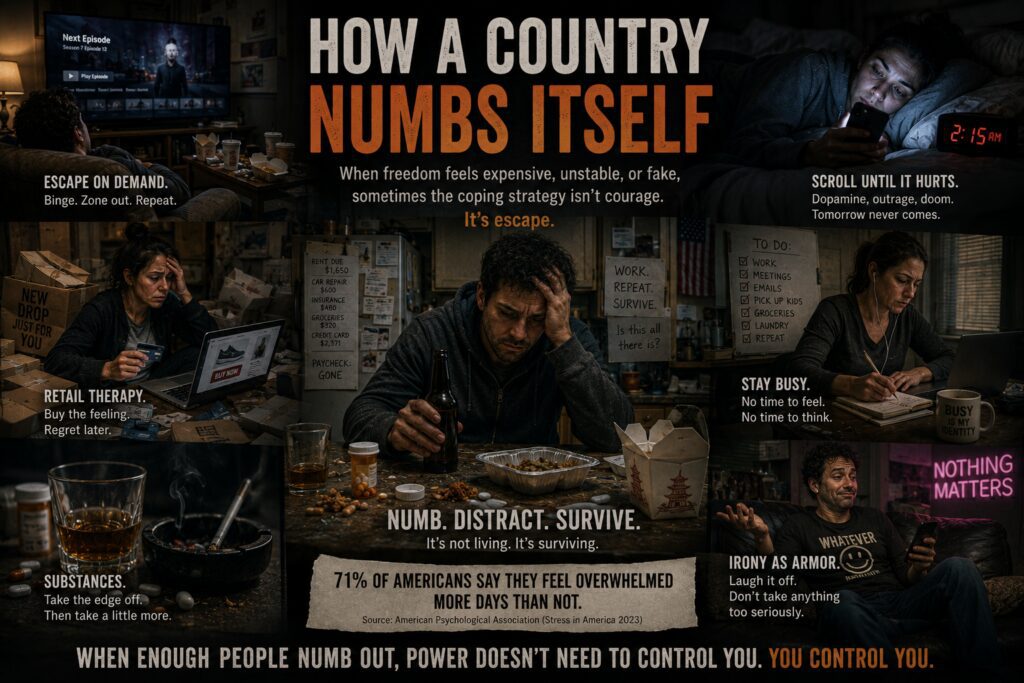
If freedom starts feeling expensive, unstable, exhausting, or mostly theoretical, people don’t
always rise up and reclaim it. Sometimes they pour another drink, buy something they don’t
need, scroll until midnight, stay busy enough not to think, and call that coping because it gets
them through Thursday.
One of the stranger things about freedom is that people don’t always know what to do with it
when it starts feeling bad.
We like to imagine ourselves as noble little liberty creatures.
Give us enough pressure, enough unfairness, enough institutional betrayal, enough daily
absurdity, and eventually we’ll reclaim our agency.
Question the system.
Throw off the chains.
Delete the apps.
Leave the dead-end job.
Heal the nervous system.
Drink more water.
Become a symbol of resilience in flattering lighting.
That’s a lovely story.
It also isn’t usually what overwhelmed people do.
A lot of the time, they numb.
Not because they’re weak.
Not because they don’t care.
Because when life starts feeling unstable and exhausting, rebellion isn’t always the nervous
system’s first choice.
Relief is.
And relief doesn’t always look noble.
Sometimes it looks like doomscrolling until your eyes hurt.
A second glass of wine.
Buying things you didn’t need because Tuesday deserves a package.
Weed.
Shopping.
Sugar.
Porn.
Gambling.
Fantasy football.
Ten straight hours of YouTube explaining why civilization is collapsing.
Or simply staying so busy you never have to hear your own life making noises.
Busyness is one of the more socially acceptable forms of numbing.
If you’re distracting yourself with work, side hustles, errands, productivity, meal prep, and colorcoded determination, people tend to call you responsible instead of dissociated.
Functionally, though, it can be the same move.
Keep moving.
Keep consuming.
Keep refreshing.
Keep performing.
Keep the silence filled with something loud enough to drown out the suspicion that this whole
arrangement might be making you unwell.
That’s why I think coping belongs in the freedom conversation.
If freedom is supposed to mean agency and meaningful choice, it matters what people do when
life starts feeling like a maze they can’t afford to escape.
Sometimes they fight.
Sometimes they organize.
Sometimes they push for change.
But often they adapt to powerlessness by finding ways not to feel it quite so completely.
Not just addiction in the clinical sense.
The broader ecosystem of numbing.
The thousand little ways people sedate consciousness just enough to keep participating in a life
they don’t fully trust, don’t fully control, and increasingly don’t have the bandwidth to fix.
Because if you can’t change the system…
Can’t leave the job…
Can’t get the doctor to call back…
Can’t make the bills shrink…
Then the question quietly shifts.
Not:
How do I become free?
But:
How do I make this tolerable enough to do again tomorrow?
That’s a different question.
And it produces different behaviors.
Not liberation.
Manageable anesthesia.
A little scrolling.
A little drinking.
A little spending.
A little binge-watching.
A little emotional detachment.
Just enough distraction to soften the trapped feeling humming underneath everyday life.
I’m not above any of this.
I’m certainly not writing from a mountaintop wearing linen and eating chia seeds with the serene
wisdom of someone who has transcended avoidance.
LMMFAO.
I understand the appeal.
Most people probably do.
That’s what makes it interesting.
The numbing isn’t random.
It follows the pressure.
It follows the places where people feel least powerful.
Least safe.
Least able to meaningfully change their lives.
Zoom out far enough and it starts looking less like individual failure and more like a national
coping style.
Record levels of distraction.
Entertainment.
Shopping.
Convenience.
Digital escape.
Algorithmically engineered dopamine.
None of that exists in a vacuum.
It exists in a country where people are tired.
Tired of bills.
Politics.
Institutions.
Work swallowing life.
Being reachable all the time.
Trying to stay informed without becoming emotionally radioactive.
Eventually people stop trying to solve everything.
They start trying to survive the feeling of it.
That’s one reason doomscrolling makes more sense than people admit.
People mock it as weakness.
Often it’s an anxious attempt at control.
If I keep looking…
Maybe I’ll understand.
Maybe I’ll be prepared.
Of course it usually backfires.
Instead of clarity, it creates overstimulation.
Instead of safety, dread.
Instead of agency, the exhausted helplessness of a raccoon digging through the same trash can
for the fifteenth time hoping this time it contains closure.
But psychologically?
It makes sense.
People numb in the direction that matches the shape of their pain.
The woman shopping may be buying relief from emptiness.
The man drinking may be buying silence from a brain that won’t stop bracing.
The permanently busy person may be buying distance from grief.
The person living online may be buying belonging, distraction, identity, or the illusion of
preparedness.
Not all coping is pathology.
Some of it is recreation.
Some of it is comfort.
We’re allowed to enjoy life without turning every streaming subscription into a sociological case
study.
But there’s a point where comfort stops restoring us and starts anesthetizing us.
I think America has gotten very good at confusing the two.
We call it self-care when sometimes it’s sedation with better branding.
We call it unwinding when sometimes it’s avoidance with snacks.
We call it staying informed when sometimes it’s panic dressed as civic engagement.
We call it hustle when sometimes it’s a trauma response with a planner.
I’m not judging.
I’m saying the line is thinner than we like to admit.
If millions of people no longer believe they can meaningfully influence the conditions shaping
their lives, numbing becomes understandable.
Powerlessness is hard to metabolize.
Especially in a culture that still expects optimism, productivity, gratitude, resilience, and
emotional self-management while people juggle rent, illness, grief, bureaucracy, overstimulation,
and a news cycle that behaves like it’s being run by a caffeine-addicted raccoon with access to
missile alerts.
Eventually people close the door a little.
With substances.
Entertainment.
Shopping.
Work.
Sarcasm.
Busyness.
Sleep.
Anger.
Whatever keeps the existential screaming at a manageable indoor volume.
It doesn’t solve the problem.
But it makes sense.
And that may be the most uncomfortable part.
The coping is often rational inside irrational conditions.
What else would we expect?
A fully regulated, civically engaged population with excellent boundaries and a restorative
bedtime routine?
That would be adorable.
But it isn’t the country we built.
We built a culture that praises freedom while exhausting people.
Sells autonomy while monetizing dependency.
Rewards dysregulation.
Turns rest into a luxury and margin into a class privilege.
Then acts surprised when people cope like they’re on their own.
That’s why coping belongs in the freedom conversation.
Because what a society uses to numb itself tells you something about how livable that society
feels from the inside.
It tells you where the pressure is.
Where the grief is.
Where people have stopped expecting meaningful relief and started settling for manageable
distraction.
If you want to understand a country, don’t just ask what it claims to value.
Ask what it needs to get through the week without fully feeling itself.
Apparently, for a lot of us, the answer is an app, a drink, an unnecessary purchase, relentless
busyness, and just enough dark humor to make it to Friday.
It may not be inspiring.
But it does feel honest.
About Us
If this place sparked something in you—or just made you feel a little less alone while mentally spiraling—drop a tip in the flame fund. I built this place while burning out. Now it runs on caffeine, survival grit, and scrolls of half-sane truth.