What Did We Mean by Freedom in the First Place?
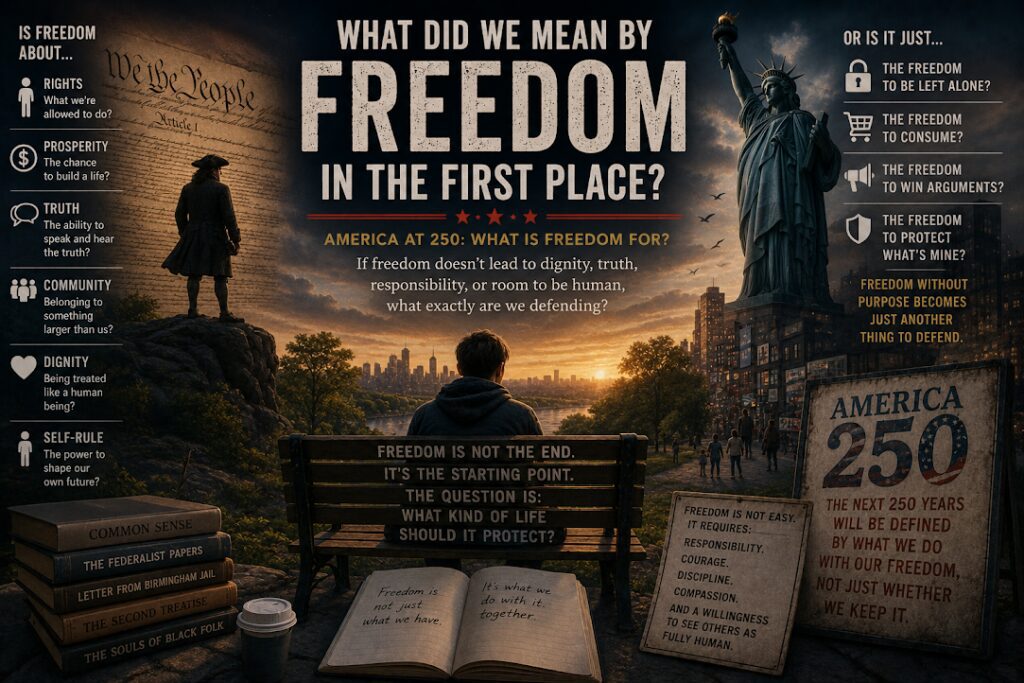
It is possible to spend so much time arguing over whether a country is free that we forget to ask
a more important question:
What kind of human life is freedom supposed to protect?
America is turning 250, which means freedom is once again being polished for company.
It will appear in speeches, anniversary branding, and familiar civic language.
Liberty.
Independence.
Self-government.
The American experiment.
The blessings of freedom.
Every nation tells stories about itself. Values become symbols, rituals, and traditions.
But the older I get, the less interested I am in hearing people praise freedom.
I want to know what they think it’s for.
Not whether it appears in founding documents.
Not whether politicians can point at a flag while saying the right words.
What kind of human life is liberty actually meant to protect once the speeches are over?
That’s the question I keep coming back to.
Because after a while, freedom becomes one of those words everyone reveres while meaning
something different by it.
For some people, freedom means being left alone.
No government interference.
No one telling you how to live.
For others, it means rights.
Speech.
Religion.
Due process.
Bodily autonomy.
Protection from arbitrary power.
For others, it means self-government.
Citizens ruling themselves instead of being ruled.
Participation instead of obedience.
Some see freedom as opportunity—the ability to build a life, support a family, own something,
and move forward without unnecessary barriers.
Others see it as truth—the ability to ask difficult questions, challenge power, and refuse loyalty
to lies.
Others think of dignity.
Not simply surviving, but remaining fully human.
Having room to rest.
Think.
Grieve.
Belong.
Develop a conscience instead of merely a coping strategy.
And for many people, freedom simply means:
“Please let me keep whatever little part of life still feels like mine.”
The problem is that those are not all the same vision.
We’ve been using one sacred word to describe a dozen different ideas.
That matters.
Because if freedom only means the absence of interference, we can end up protecting lives that
are legally unrestricted but spiritually hollow.
People can be left alone to drown in debt.
Work themselves into exhaustion.
Be manipulated, isolated, overmedicated, underpaid, and algorithmically managed without
anyone technically violating their liberty.
That’s a kind of freedom.
But it’s a bleak one.
If freedom only means consumer choice, liberty starts looking suspiciously like shopping.
Choose your streaming service.
Choose your debt.
Choose your insurance nightmare.
Choose which corporation manages your attention, your relationships, and your nervous
system.
Again, that’s a form of freedom.
But it’s a strange foundation for a national ideal.
Rights matter deeply.
Without them, liberty cannot survive.
But rights alone don’t tell us what kind of life we’re protecting.
They tell us what power cannot do.
They don’t tell us what freedom should make possible.
That’s where the question becomes more interesting.
Freedom isn’t just a shield.
It’s the condition that allows truth, responsibility, creativity, community, meaningful work, private
thought, moral agency, and love to flourish.
Not a perfect life.
Just one with enough room to become a person instead of merely a unit of labor, consumption,
compliance, and stress.
To me, that’s closer to the point.
Freedom should protect the conditions under which people can tell the truth without being
destroyed for it.
Think without constant manipulation.
Care for family without being crushed by the cost.
Say no to abuse.
Rest without shame.
Take responsibility for their lives without carrying every structural failure of society as a personal
moral defect.
Freedom should make room for dignity.
Not Hallmark-card dignity.
The deeper kind.
The ability to remain fully human.
Not merely productive.
Not merely compliant.
Not merely legally unchained while being psychologically cornered, economically squeezed, and
digitally herded.
Responsibility matters too.
Freedom without responsibility eventually becomes appetite.
My wants.
My comfort.
My outrage.
My rights detached from truth, restraint, and concern for others.
Responsibility without freedom becomes obedience.
A healthy society needs both.
Enough liberty for people to remain fully human.
Enough responsibility to keep liberty from becoming exploitation or narcissism.
That brings me back to America’s 250th birthday.
The real question isn’t whether we can still produce fireworks and patriotic speeches.
It’s whether we still remember what liberty was for.
Was freedom meant to create isolated consumers responsible for surviving systems too large to
challenge?
A society where people can technically say anything while living inside information systems
designed to manipulate them and economic systems designed to exhaust them?
I hope not.
I think liberty was meant to serve something larger than markets, elections, or national
mythology.
I think it was meant to make genuine self-government possible.
Not just at the ballot box.
Inside families.
Communities.
Conscience.
Daily life.
Real self-government requires citizens capable of reality-based thinking.
Truth.
Restraint.
Responsibility without servility.
Freedom without narcissism.
Belonging without demanding conformity.
Disagreement without craving domination.
That vision asks more of us than bumper-sticker patriotism ever will.
America has never fully lived up to it.
Its history is full of contradictions.
Freedom proclaimed.
Freedom denied.
Freedom expanded.
Freedom restricted.
Freedom commercialized.
But failing an ideal doesn’t make the ideal meaningless.
Sometimes it means the ideal is difficult.
Maybe that’s what a 250th anniversary should be for.
Not simply celebrating what America says about itself.
But asking whether its defining words still point toward a life worth defending.
If freedom no longer protects truth, dignity, responsibility, conscience, and enough room to be
fully human—
what exactly are we defending?
A slogan?
A logo?
A market arrangement?
A legal framework?
A memory?
I don’t ask that cynically.
I ask because words this important should still have a pulse.
They should still connect to ordinary human life.
Maybe that is what freedom has always been for.
Not perfection.
Not comfort.
Not self-congratulation.
But protecting the conditions where truth, dignity, responsibility, and self-government can
actually flourish.
If that’s still the goal, then 250 years feels like the right time to ask how much of it we’re truly
building.
About Us
If this place sparked something in you—or just made you feel a little less alone while mentally spiraling—drop a tip in the flame fund. I built this place while burning out. Now it runs on caffeine, survival grit, and scrolls of half-sane truth.