The Most Effective Censorship Doesn’t Feel Like Censorship
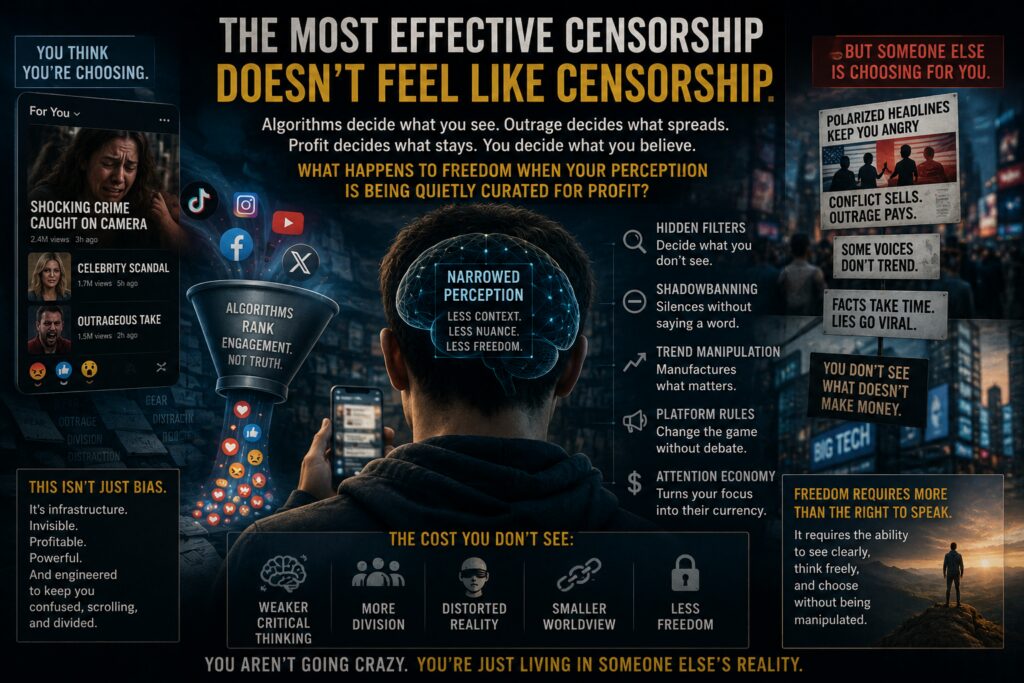
Freedom in the digital age isn’t just about whether you’re allowed to speak. It’s also about who
gets amplified, what gets buried, what keeps showing up in your feed, and how much of your
reality is quietly arranged before you ever decide what you think.
Americans usually picture censorship in dramatic terms.
Books being banned.
Governments silencing critics.
Journalists disappearing.
Speech becoming a crime.
It’s obvious.
Visible.
Easy to condemn.
But one of the strangest things about modern freedom is that much of today’s control doesn’t
look like censorship at all.
It looks like convenience.
A feed built just for you.
Search results tailored to relevance.
Recommendations that help you “discover” what matters.
Platforms deciding what’s engaging, trustworthy, safe, or profitable.
Nobody has to ban your speech if they can quietly rearrange the room around it.
That’s the conversation I think we’re still learning how to have.
Most free speech debates end up in one of two predictable camps.
Either nothing counts as censorship unless the government literally forbids speech.
Or every moderation decision becomes proof civilization is collapsing.
I’m less interested in either argument than I am in the environment itself.
The information environment.
The attention environment.
The invisible machinery deciding what rises, what sinks, what trends, what disappears, and
what keeps showing up until it starts feeling like common sense.
Because digital freedom isn’t just about whether you’re allowed to speak.
It’s also about whether anyone ever hears you.
What information reaches you first.
Which stories feel urgent.
Which quietly disappear.
What emotional tone keeps getting rewarded.
That’s where the conversation changes.
Traditional censorship removes information.
Modern influence often sorts attention.
It shapes visibility.
Reach.
Context.
Repetition.
It quietly influences what feels credible, fringe, dangerous, ordinary, or important.
That’s a different kind of power.
If you can shape what millions of people repeatedly see, you aren’t simply influencing
conversation.
You’re influencing perception.
And perception is where much of modern freedom now lives.
People don’t respond to reality in the abstract.
They respond to the version of reality that reaches them.
The version repeated often enough to feel familiar.
The version framed as obvious before they’ve had time to examine it.
That’s less like old-fashioned censorship.
It’s curation with consequences.
Digital life now sits between people and reality so completely that it no longer feels like an
intermediary.
It simply feels like life.
News arrives there.
Politics arrives there.
Community arrives there.
Fear arrives there.
Conspiracy arrives there.
So does genuine connection—which is exactly why this becomes complicated.
These same platforms help people learn, organize, and find each other.
They also shape attention at a scale no human nervous system evolved to navigate.
And they aren’t doing it as a public service.
They’re doing it because attention is profitable.
That’s the part I wish more free speech conversations acknowledged.
Most digital systems aren’t optimized to create thoughtful, well-informed citizens.
They’re optimized for engagement.
And engagement rewards emotional intensity.
Conflict.
Novelty.
Fear.
Certainty.
Outrage.
Tribal identity.
The emotional reward of feeling right, threatened, vindicated, or morally superior.
Those aren’t necessarily partisan incentives.
They’re structural ones.
Keep people scrolling.
Keep people reacting.
Keep people emotionally invested.
Once you understand that, the freedom question changes.
It isn’t only:
Can people speak?
It’s also:
What kind of reality are they being encouraged to perceive?
What keeps appearing?
What quietly disappears?
What gets framed as consensus?
What gets dismissed before it has a chance to be considered?
If perception is constantly being curated for profit, then freedom is already being shaped before
“choice” even begins.
Your emotional weather is being shaped.
Your sense of threat.
Your sense of proportion.
Your sense of what everyone else supposedly believes.
That doesn’t mean people are helpless.
People can think critically.
Seek better information.
Log off.
Resist manipulation.
But the environment still matters.
Digital platforms aren’t passive mirrors.
They’re active filters.
That becomes especially important when politics and fear enter the equation.
Algorithms have no moral reason to stop feeding people whatever keeps them engaged.
They don’t distinguish between informed citizens and emotionally combustible ones.
They distinguish between people who stay and people who leave.
That’s why so much online political life feels like a hall of mirrors built by a marketing department
and accidentally handed control of public discourse.
People begin confusing repetition with importance.
Exposure with truth.
Virality with significance.
Silence with irrelevance.
Control doesn’t always require a single villain.
Sometimes it emerges from incentives.
Recommendation systems.
Search rankings.
Advertising pressure.
Platform design.
Algorithms quietly rewarding some behaviors while starving others.
That’s why I keep returning to the same idea.
The most effective censorship rarely feels like censorship.
Sometimes it feels like personalization.
Relevance.
Convenience.
Safety.
“The algorithm just knows me.”
Nobody technically stopped you from speaking.
Meanwhile, the room has already been rearranged.
The loudest voices amplified.
The quieter ones buried.
The emotional temperature raised.
Communities sorted into separate realities.
Each convinced they’re simply seeing the truth more clearly than everyone else.
That isn’t a healthy information environment for a free society.
Especially in a country celebrating 250 years of liberty while spending more and more of its
public life inside privately owned digital systems.
Because freedom isn’t just the right to open your mouth.
It’s the ability to encounter reality without every piece of it being filtered through systems
optimized for engagement, profit, and behavioral prediction.
To think without your attention constantly being hijacked.
To search without invisible incentives shaping what appears first.
To disagree without every conflict becoming content.
I’m not suggesting there was ever a perfectly pure public square.
Propaganda isn’t new.
Power isn’t new.
Narrative control isn’t new.
What’s new is the scale.
The speed.
The intimacy.
And the invisibility.
More of modern life now unfolds inside privately owned attention systems whose incentives
don’t neatly align with truth, mental health, or democratic life.
That feels worth talking about when we talk about freedom.
Because maybe the question is no longer just whether Americans are allowed to speak.
Maybe it’s whether we can still perceive clearly inside environments designed to curate reality
for profit.
And if the answer is “not as clearly as we think,” then that’s a freedom problem too.
Not because anyone burned the Constitution.
Because they built a feed.
About Us
If this place sparked something in you—or just made you feel a little less alone while mentally spiraling—drop a tip in the flame fund. I built this place while burning out. Now it runs on caffeine, survival grit, and scrolls of half-sane truth.